Constellations
Ecce, Cassiopeia!
This month we’re looking up at the sky for some Classically inspired constellations. We’re exploring five basic constellations, drawing constellations, Claudius Ptolemy, the words “stellar” and “astronaut,” and more!
Table of Contents
I. LATIN: A DISCUSSION ABOUT FIVE BASIC CONSTELLATIONS
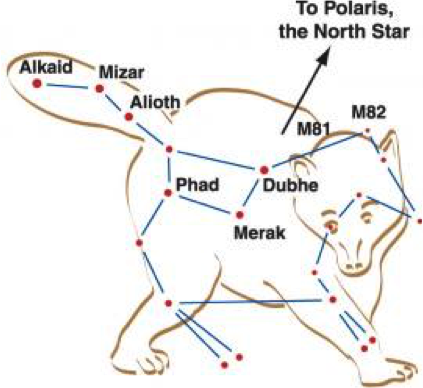
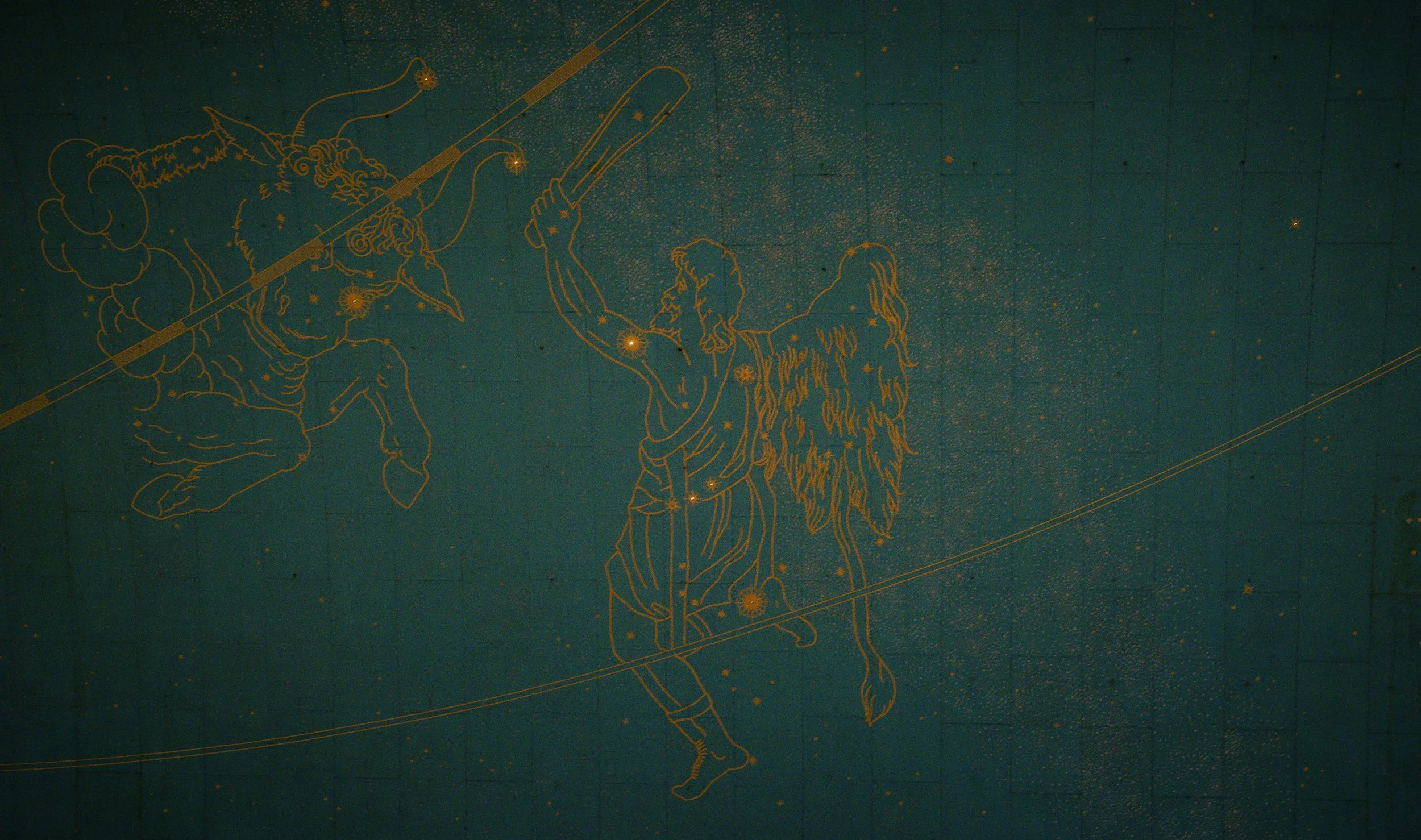
Ursa Major, Orion, the Pleiades, Cassiopeia, and Gemini
Background: Our English word “constellation” is from the Latin “stella” and means “set with stars.” Many of the 88 constellations that we recognize today date back to Greek and Roman times. Knowledge of the stars helped farmers with their agricultural planning, as well as sailors with their navigation. We continue to use the constellations’ Latin names, and many have fascinating myths associated with them. Even students who have not previously studied the constellations can quickly learn to recognize some basic recognizable ones. They can be proud of their newfound skill, which is one they can put to use throughout their lives!
Introduction: This is a basic introduction to five constellations: Ursa Major, Orion, the Pleiades, Cassiopeia, and Gemini. Following an introductory PowerPoint and Latin conversation modeled by the teacher, students will practice recognizing these constellations and speaking some Latin sentences about them.
Objectives: Students will identify five constellations, practice saying Latin sentences, connect Latin to the present (since we see constellations today as well!), and use Latin in a real, meaningful context.
Special Concerns: Some students may have a Latin background beyond the simple practice sentences provided in this lesson. In that case, adding more Latin sentences for them to use in the class conversation could be helpful. Students could even be asked to compose their own sentence to describe each constellation.
Materials:
PowerPoint: Introduction to the Constellations
Copies of the constellations card game (one set for every group of 3-4 students)
Procedures:
1: Find out what students already know about the constellations. (For younger students who may not be familiar with the term “constellations,” ask them what they know about the stars in the sky.) A quick think-pair-share could be great for getting them talking: Ask students to take one minute to jot down everything that they already know about constellations. Then ask them to share with a neighbor for a minute. Finally, ask each pair to share a fact with the rest of the class.
2: Share with the class the PowerPoint presentation, Introduction to the Constellations. This presentation will provide an overview of five basic constellations: Ursa Major, Orion, the Pleiades, Cassiopeia, and the Gemini.
3: Leaving projected the final slide of the PowerPoint presentation (the sky map), have students practice recognizing these constellations with a short, Latin conversation:
Say, “ubi est [Ursa Major / Orion / Cassiopeia]?” or “ubi sunt [Pleiades / Gemini]?”
Students take turns pointing out the requested constellation and presenting it using, “ecce, ______________ [name of constellation]!”
4: After a little practice with the whole class, students will work in groups to practice speaking some Latin sentences and recognizing these constellations. Divide the class into groups of three or four students, and give each group a set of the constellations card game. The teacher can have the groups do any kind of activity or game with the cards, but here are some suggestions:
The group places all fifteen cards face-up on the table (mixed up) and works together to match each constellation’s name, Latin sentence clue, and drawing.
When students feel comfortable with the task above, they could have one student read a Latin clue card aloud, and then the rest of the group must choose the picture and constellation name that goes with it.
Students could then place all 15 cards face-down and play a Memory game. They must find all three cards for each constellation in order to make a matched set.
*Feel free to remove cards from the game, depending on the ability level of your students!
II. DRAWING THE CONSTELLATIONS
Cassiopeia, Leo, Ursa Major, Orion, Hercules, Cepheus, and Cancer
Background: It can be difficult to identify constellations because the shapes don’t look much like the animals or heroes depicted. This activity will help students form the shapes from the stars and connect the patterns to the images and myths they inspired.
Introduction: Students will draw the constellations by connecting the dots using Roman numbers on a worksheet and then by making Paper Cup Constellations.
Special Concerns: The Roman numerals version of the Connect-the-Dots worksheet assumes a basic understanding of Roman numerals. Check out our Math and Numerals Shooting Star page for several activities for teaching and practicing Roman numerals which could be useful for students who do not already know them. For teachers who do not wish to teach Roman numerals at this time, we have included an alternate version of the worksheet, which uses Arabic numerals.
Objectives: Students will practice Roman numerals and will make connections to today through identifying constellations.
Materials:
Constellations Connect-the-Dots worksheet: Roman Numerals version or Arabic Numerals version
Paper cups (any size)
Wooden skewers with pointed tips or sharpened pencils
One flashlight for the class
Procedures:
Individual and Group Practice: Give students the Constellations Connect-the-Dots worksheet and have them complete it and check with peers around them for accuracy.
Informal Assessment: Have the students make “paper cup constellations” to practice drawing the constellations by freehand.
Each student first draws a constellation of his choice in pencil on the bottom of the cup, marking the major stars.
Next, he should use the pencil or wooden skewer to poke a hole through each star.
When the paper cup constellations are ready, turn off the lights and choose a student to place his or her paper cup over the flashlight.
Students can take turns shining their constellations on the ceiling while the rest of the class guesses which constellations they are.
III. ADDITIONAL IDEAS:
Of course, there is so much more to explore with constellations! Here are a few additional ideas for teachers who would like to extend students’ study of constellations:
Assign each student in the class a different constellation to research and to present to the class. When the students present their constellation research, have them draw the constellation on a wall-size star chart. By the end of the presentations, students will be able to see drawings of all the constellations studied and their general locations in relation to one another.
Younger students might enjoy inventing their own constellations and creating short myths to go along with them. They can put star stickers on a piece of paper and illustrate their drawing around the stars.
Plan a star-gazing night for your class or Latin Club! Students will be proud of themselves for all of the constellations they can find!
Online Resources: Constellation Hunt & The Night Sky app
This month, we just couldn’t choose, so we have two resources to share!
1. Constellation Hunt: http://www.kidsastronomy.com/astroskymap/constellation_hunt.htm
This “Constellation Hunt” game shows a drawing of the starry sky and asks students to locate certain constellations. If students need help, they can view a drawing of the sky that includes lines connecting the constellations (instead of just seeing only the stars). After a bit of practice, students will be ready to star-gaze in real life!
2. The Night Sky app: https://appsto.re/us/MF7wC.i
The iPhone app, The Night Sky, by iCandy Apps,helps you to find the constellations when you hold the iPhone or iPad up toward the sky. By pointing your device upward toward the sky, the app can point out stars, planets, and constellations. It has the Latin names for many constellations as its default, so this could be an excellent additional resource for Latin students to explore!
Famous Romans: Claudius Ptolemy
Claudius Ptolemy lived in Alexandria in the 2nd Century A.D. and was an astronomer, geographer, and mathematician. He wrote a book on astronomy called the Amalgest, which included the most thorough star catalog of ancient times. This star catalog grouped 1,022 stars into 48 different constellations; this list forms the basis for our modern list of 88 constellations. (Ptolemy’s catalog itself was based on a previous list by a scholar named Hipparchus, who only included the constellations that could be seen from Greece. As a result, Ptolemy’s list did not include those constellations which can only be seen from the Southern Hemisphere.)
Another interesting work by Ptolemy is his Geography, which described the geography of the world as the Greeks and Romans knew it. The Geography remained the principal source on this topic for centuries and was even used by Christopher Columbus.
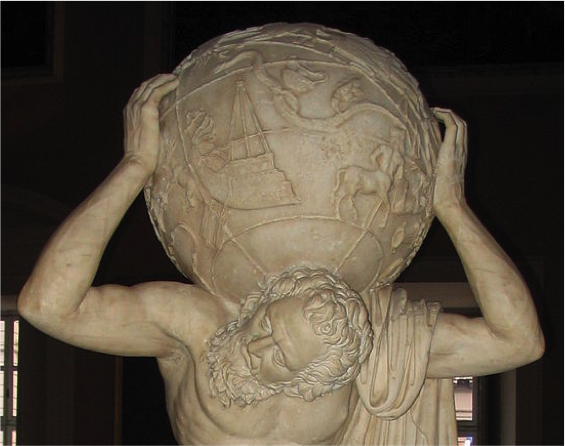
This is a picture of the Farnese Atlas, a 2nd Century Roman copy of a Greek statue of Atlas bearing the sphere of the heavens on his shoulders. The sphere includes relief sculptures of at least 40 of the 48 constellations listed by Ptolemy and is the oldest surviving pictoral representation of the celestial sphere.
Random Find: Twilight Turtle Night Light
htp://cloudb.com/US/sight/twilight-turtle-classic-mocha
How we found it: A science teacher at Skye Shirley’s school asked if she would like to borrow this product for a Classical Roots class. Young students (or even older students!) love to lie on the carpet, look up at the “stars” on the ceiling and learn the names and myths behind each constellation.
How you can use this: Among the many stars which the Twilight Turtle Night Light projects onto the ceiling are some constellations. The product we looked at includes:
Ursa Major
The Little Dipper
Orion
Gemini
Draco
Pegasus
Canis Major
Cepheus
Teachers can turn on the light and ask students to point out as many of the constellations as they can. Teachers can also point out any constellations they have not already taught to the class, and the students can listen to the story behind each one.
Featured Words: stellar and astronaut
We chose two words for this topic because they go together so well!
“Stellar” comes from “stella,” which is a Latin word for “star.” Explain to students that it can refer to stars, but that it can also mean “outstanding,” or “exceptionally good.” Ask students if they can figure out how that second meaning relates to the “star” root.
“Astronaut” comes from “astrum,” another Latin word for “star,” and also “nauta,” which beginning Latin students might recognize as the word for “sailor.” Ask students to use this information to deduce the most literal meaning behind “astronaut.”
Other words from “stella” and “astrum” include constellations, astronomy, and astronomical.
Advice & Questions
Q: Do you notice anything unusual about the bears in Ursa Major and Ursa Minor?
A: Students will probably come up with many answers. However, we hope they will notice that both bears have long tails! Remind students that real bears have short, stumpy tails. Ask them if they can think of a reason for these long tails. This could be quite a thought-provoking conversation, because no one knows the answer! One mythological explanation is that the tails are long because they were stretched when Zeus flung both bears into the sky.
Posted on October 19, 2015 by Kevin Jefferson