

Mythological Couples
Stories of mythological couples, valentine cards and shoeboxes, Valentinus, mythology charm bracelets, the word “cherish,” and more!
1. CULTURE LESSON: STORIES OF MYTHOLOGICAL COUPLES
Introduction: In this lesson, students will get to know the stories of three couples from mythology through readings, discussion questions, skits, and a crossword puzzle.
Background: Forbidden love, lost love, and longtime love. The Romans’ stories had it all! The Roman poet Ovid told all three of these myths in the Metamorphoses. While our short one-page versions are suitable for younger students, older students may enjoy reading an English translation of Ovid, whose descriptions are fantastic.
Objectives: Students will be able to tell about the characters and plot for three stories of mythological couples: Pyramus and Thisbe, Orpheus and Eurydice, and Baucis and Philemon.
Materials:
Copies of the three readings:
Copies of the discussion questions page
Copies of the Mythological Couples crossword puzzle and answer key
N.B. – The first two readings above are from the Ascanius publication Mingle with Myth, which contains a full lesson on each of these myths, plus many more.
Procedure:
Divide students into small groups. Each group should read the first story’s discussion questions together and then read the story silently. Then they should discuss the answers to the story’s questions. They should repeat this procedure with the other two stories.
Next, each group should be assigned one of the stories. They should plan a short skit (about five minutes) which they will present to the rest of the class in order to get to know the story better.
The groups share their skits with the rest of the class.
Students check their understanding of these three stories by completing the crossword puzzle.
2. LATIN LESSON: MYTHOLOGICAL VALENTINES
Introduction: Delivering little valentine cards to decorated shoeboxes is a classic February activity! In this lesson, students will use their knowledge of the three myths explored above to create valentines from one character to another. They will write them in Latin and will have to think carefully and creatively to compose from each character’s perspective.
Objectives: Students will compose simple Latin sentences with adjectives and will demonstrate an understanding of three myths about mythological couples.
Special Concerns: This lesson assumes prior knowledge of these three myths. Students can gain familiarity with these stories by using the materials in Lesson 1 of this issue.
Materials:
Copies of the Myth Couple Valentines materials (all three pages in this one file):
Brainstorming page
List of Latin adjectives and Valentine’s phrases
Valentine cards page (Students will cut these out.)
Colored pencils, markers, or crayons
For creating a card box for each character:
6 Shoeboxes
construction paper
scissors
glue sticks
Procedure:
1: Explain to students that they will write small valentine cards to each character in these myths, writing from the perspective of each character’s significant other.
Pyramus and Thisbe
Orpheus and Eurydice
Baucis and Philemon
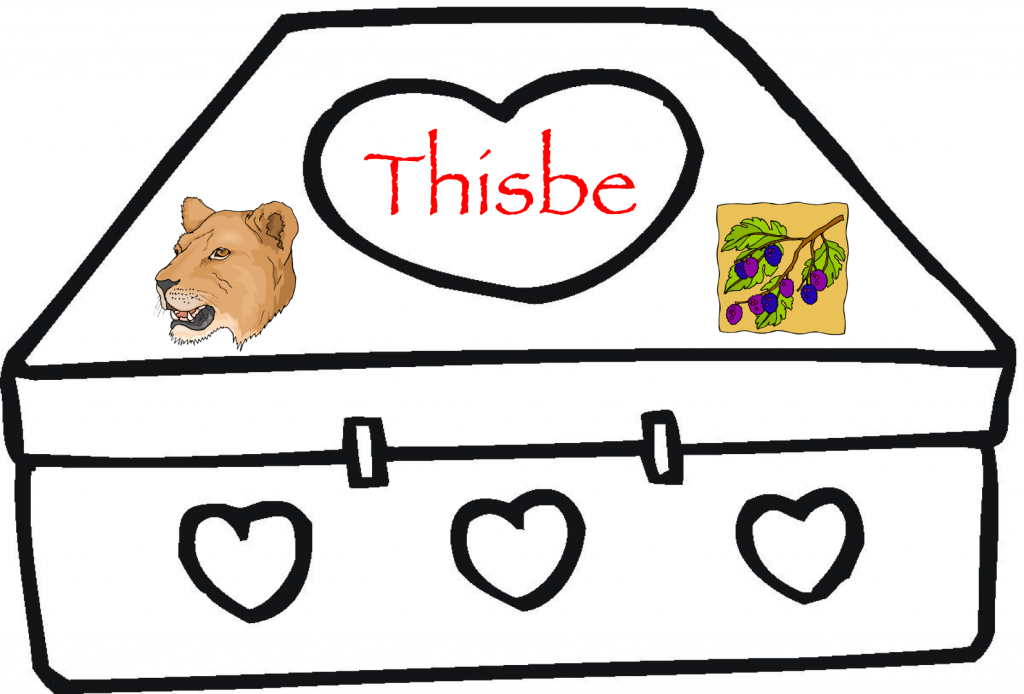
2: Divide the class into groups, and assign each group a character. Each group will decorate a shoebox to be used as a box in which the assigned character will receive cards. They should cut a card-delivery slot and decorate the box in a way that reflects the character’s story.
3: Next, students should work individually to create their valentine cards:
The brainstorming page can help them to plan their cards.
Using the handout containing Latin adjectives, they should compose a brief Latin valentine for each character. Students can use the simple sentence, “tu es __________,” with a fitting adjective in the blank. They should be careful to use the correct gender of the adjective. They can also add the Valentine’s Day phrases from the bottom of the page. More advanced students can add more words and details.
Students should then cut out the six cards, write their Latin valentine compositions on them, and add appropriate illustrations.
*They may use either the front of the card, the back of the card, or both.
4: Finally, students deliver the characters’ valentines to the correct boxes. Afterwards, groups can take turns visiting each character’s box and reading his or her valentines. Perhaps the class could even vote for the sweetest card, the most creative card, etc.
Online Resource: Be Funky Graphic Designer
Be Funky Graphic Designer
https://www.befunky.com/create/designer/
Be Funky may be best known for their Photo Editor, but their Graphic Designer could also be a useful tool. It has templates and easy-to-use design tools, but the best part is the wide access to images. Users can upload their own photos or search over 430,000 images through Pixabay and then insert them into their design.
The Be Funky Graphic Designer would be a great choice for a class that wants to create its mythological couples valentine cards on the computer!
Famous Roman: Valentinus
There are many stories about Valentinus. Most of them seem to agree that Valentinus or “Valentine” was a Christian bishop or priest in the 3rd century, but that when he tried to convert the Roman Emperor Claudius II to Christianity, he was put to death. One story tells that Valentine cured a young girl’s blindness, and that her father, who was a judge, converted to Christianity as a result. Another story says that Valentine officiated at the marriage ceremonies of Christian couples, in secret, because at the time, Christianity was not the official religion of the Roman Empire. Most sources agree that Valentine died for his faith, leading to his sainthood by the Roman Catholic Church. Many people still celebrate the date of his death–February 14–as a day to celebrate love.
Random Find: Mythology Charm Bracelets
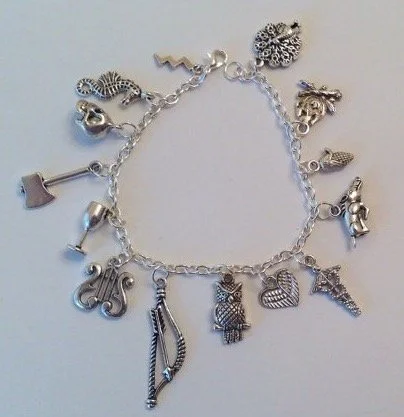
Etsy shop “Stylish Geek” sells a mythology charm bracelet that would be a unique gift for any lover of Greek mythology. Here are some related ideas for the classroom.
Possibilities:
1. Show students a picture of the bracelet, and point out how each charm represents a symbol or item associated with a certain deity. Ask students to choose one of the stories about mythological couples and to design a charm bracelet that showcases the story.
2. Challenge students to use their knowledge of Greek mythology to figure out which god or goddess each charm on the pictured bracelet represents. (All are listed at the link above.)
Featured Word: cherish
In the story of Baucis and Philemon, the elderly couple “cherished” one another so much that neither wanted to live without the other. This word, from the Latin word carus, “dear,” means to show a great deal of love for someone or to treat someone as dear. It’s an example of a word that entered the English language by way of French. The Latin word carus gave the French their word cherir, which also means “to cherish.”
Other English words from carus include “caress,” a loving touch, and “charity,” an activity or gift that benefits others. Ask students if they can figure out the connection between carus and “charity,” and help them to see that charity involves treating others dearly.